
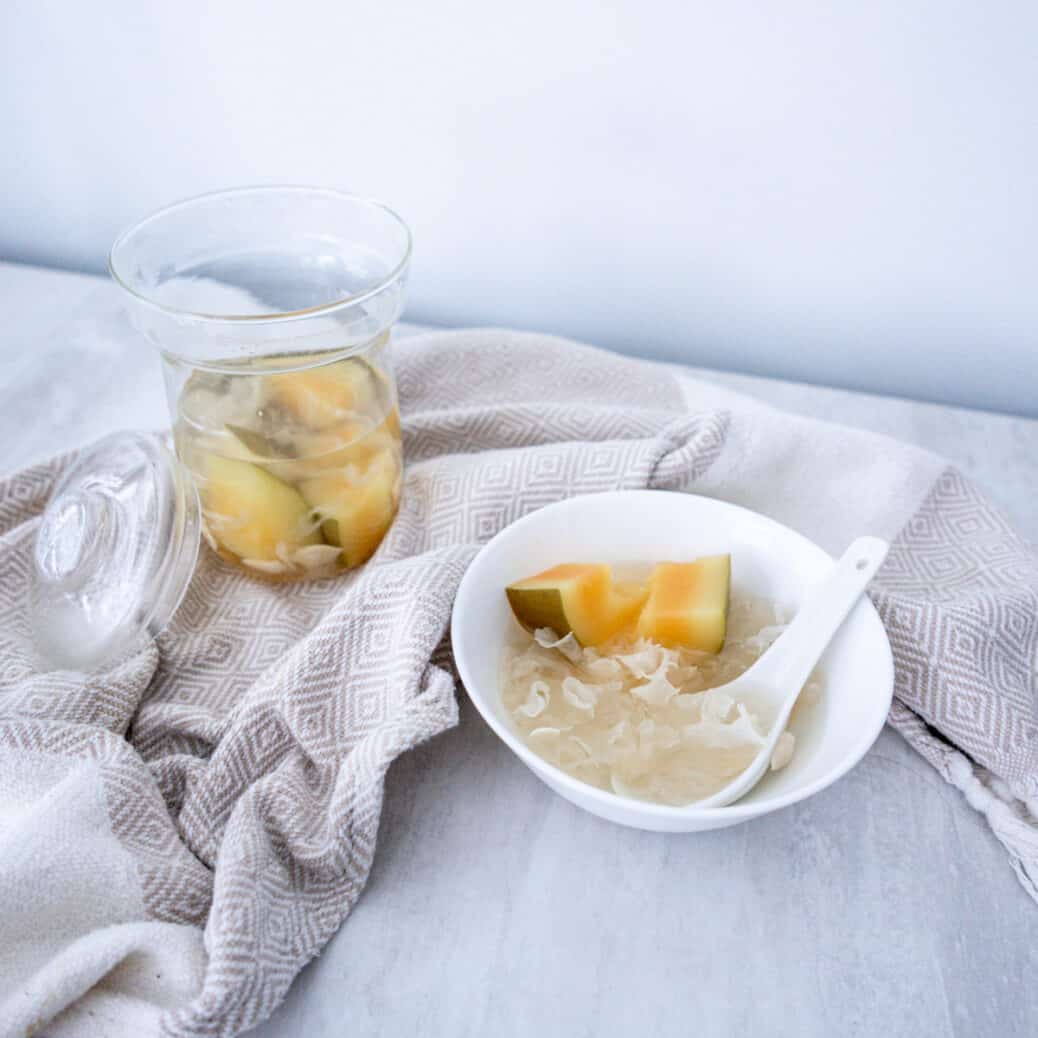
Cantonese kitchens have been turning papaya and tremella into dessert (木瓜雪耳糖水 Chinese Papaya Dessert with Snow Fungus) since long before anyone called it collagen. The fruit goes in semi-ripe so it holds its shape. The snow fungus does the actual work, softening into glossy ribbons that thicken the broth without a speck of starch.
Forty minutes on the stove gets you a bowl that moistens the Lung, settles the stomach and tastes like a tong sui shop in Sham Shui Po. Hot in October, chilled in August.
> In This Post: Everything You Need to Know About Papaya Snow Fungus Tong Sui
You'll learn why semi-ripe papaya beats fully ripe in the pot, and how to spot bleached tremella before it wastes your afternoon. We'll cover the TCM reasoning behind pairing a neutral fruit with a yin-nourishing fungus, and exactly how much apricot kernel is safe to use.
There's a T&T and Costco sourcing section with real cost-per-bowl math, plus freezer prep for families. The method runs three ways: stovetop, double-stew and Buydeem. Ten FAQs handle the questions that actually come up, including the ones about pregnancy and green papaya that people get wrong.
Jump to:
- > In This Post: Everything You Need to Know About Papaya Snow Fungus Tong Sui
- Why Papaya and Snow Fungus Work Together
- Ingredients and Chinese Herbal Benefits: TCM Properties
- Ingredient Notes and What to Look For
- Where to Buy: T&T and Costco in Canada and the US
- Instructions - Step-by-Step Cooking Method For Chinese Papaya Dessert With Snow Fungus Recipe
- Papaya Dessert Soup Frequently Asked Questions (FAQs)
- Other Yin Nourishing Dessert Recipes
- > Recipe Card
- Chinese Papaya Dessert with Snow Fungus 木瓜雪耳糖水
Why Papaya and Snow Fungus Work Together
Late August is a hinge point in the Chinese solar calendar. San Fu ends August 22 and Chushu (處暑, End of Heat) begins the next day, which means humidity drops out while the temperature stays up. Dryness moves in, and the Lung takes the hit first.
The classical answer isn't more water. It's food that generates fluids and holds them, which is what 滋陰潤燥 describes. My complete Autumn Tiger and Chushu guide maps the whole transition if you want the timing in detail.
Papaya (木瓜) sits neutral in thermal nature, sweet, entering the Spleen and Stomach meridians. It harmonizes the Stomach, aids digestion and clears summer heat without chilling anyone's digestion. That neutrality is why this bowl suits people who find pear and mung bean too cooling.
Snow fungus (雪耳) is the counterweight. Neutral, sweet and bland, entering the Lung, Stomach and Kidney meridians, it nourishes yin and moistens dryness. Cantonese cooks call it the poor cook's bird's nest, which is either humility or very good marketing.
Rock sugar isn't decoration here. TCM credits 冰糖 with moistening the Lung and generating fluids, which is why tong sui reaches for it instead of white sugar.
This is food therapy, not treatment. A cough that won't quit belongs in front of a doctor or a registered TCM practitioner.
Ingredients and Chinese Herbal Benefits: TCM Properties
Papaya (木瓜, Mù guā) is neutral and sweet, working on the Spleen and Stomach meridians. It harmonizes the Stomach, aids digestion, clears heat and quenches thirst. Semi-ripe fruit holds its wedge shape and carries more of the enzymatic character that makes it useful.
Snow Fungus (雪耳, Xuě ěr) is neutral, sweet and bland, entering the Lung, Stomach and Kidney meridians. Tremella nourishes yin, moistens dryness and generates body fluids. The gel it releases after a proper simmer is the visible form of that idea, and it's why the broth clings to the spoon.
South and North Apricot Kernels (南北杏, Nán běi xìng) are the cough element. South kernels run sweet and mild; north kernels are bitter and slightly toxic raw, so they go in cooked and in small amounts. Together they moisten the Lung, transform phlegm and ease dry cough.
Rock Sugar (冰糖, Bīng táng) is neutral and sweet, entering the Spleen and Lung. It moistens the Lung, generates fluids and calms cough without stoking internal heat.
Red Dates (紅棗, Hóng zǎo), optional but recommended, are warm and sweet, targeting the Spleen and Stomach. They tonify Qi, nourish Blood and stop a bowl of pure moisture from tipping cold on weak digestion.
Goji Berries (枸杞, Gǒu qǐ) are neutral and sweet, entering the Liver, Kidney and Lung. They nourish yin, benefit essence and brighten the eyes. Add them in the last five minutes or they turn bitter and beige.
Most dry goods ingredients, tools, and supplies can be purchased at local Asian markets, Chinese grocery stores, or Amazon Online. Amazon Prime members receive free shipping and faster delivery times.
Why Cantonese Kitchens Reach for This When Skin Feels Dry
Ask anyone's grandmother in Hong Kong what to eat when your skin goes tight and your throat scratches, and tremella comes up before anything else. The nickname is 平民燕窩, the poor cook's bird's nest, which tells you how it was valued and roughly what it cost.
In TCM terms the reasoning runs through fluids rather than skin. Snow fungus nourishes yin and generates body fluids, and dryness at the surface is read as a shortage underneath. Papaya harmonizes the Stomach so the fluids actually get transported rather than sitting undigested.
What that means in practice: this is a traditional response to a dryness pattern, eaten two or three times a week through late summer and autumn. Tremella polysaccharides are humectants, so they hold water. They don't become collagen, and no bowl of tong sui will do what a dermatologist does.
Ingredient Notes and What to Look For
Disclosure: some links below are Amazon Associates links for Amazon.ca and Amazon.com, plus one ShareASale link. If you buy through them I earn a small commission, and your price doesn't change.
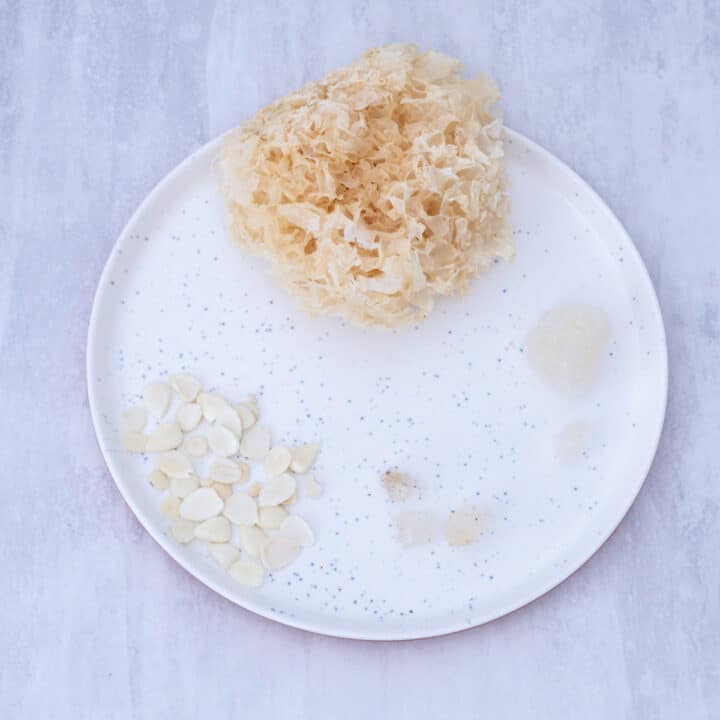
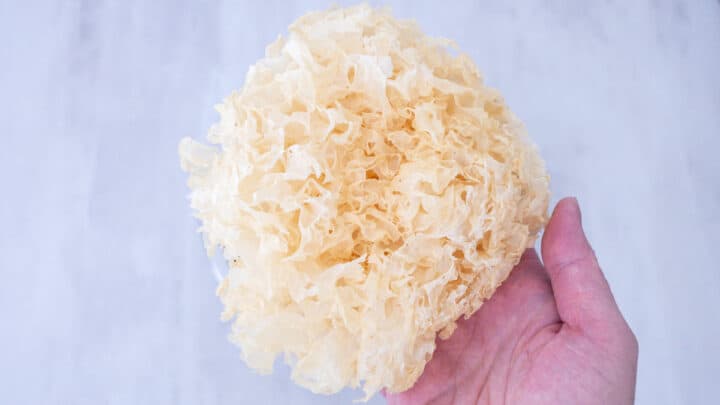
Buy dried snow fungus (Tremella fuciformis, 雪耳) in whole heads, pale ivory to faint yellow. Bright white means sulphur-bleached, and bleached tremella smells faintly chemical and turns slimy rather than springy. Whole heads let you inspect the base before you commit three hours to soaking.
Choose a papaya that's mostly green with a blush of yellow, firm with a slight give at the stem end. Fully orange fruit collapses into pulp and clouds the broth. Rock-hard green fruit never sweetens in the pot, so aim for the middle.
Apricot kernels are the one ingredient to measure rather than eyeball. Use roughly 3 parts south to 1 part north, 10 to 12 grams total for a 1.5 litre pot. North kernels (北杏) contain amygdalin and are traditionally described as toxic in quantity, which is why they always get cooked and never get scaled up casually.
Red dates should be plump, glossy and pitted before they hit the water. Yellow rock sugar (黃冰糖) gives a rounder caramel note than white, though either works. Red dates do similar Qi and Blood work in the stewed peach and snow fungus dessert, if you want the warmer late-summer version of this same base.

Where to Buy: T&T and Costco in Canada and the US
T&T is where the tremella lives. The dried goods aisle carries whole heads in 100 to 200 gram bags, and the price per gram beats the little four-head boxes at smaller grocers by a wide margin. Red dates sit in the same aisle in 400 gram or 1 kilogram bags, and the large bags are worth it because dates keep a year in a sealed jar.
Costco is the papaya run, not the herb run. The produce section usually has papaya at half what you'd pay elsewhere, and the glass storage containers and freezer bags are cheaper there than anywhere. Warehouses in areas with large Asian populations sometimes carry red dates seasonally around Lunar New Year.
In the US, 99 Ranch and H Mart cover what T&T covers. Amazon works for dried goods when your store runs out, though ordering fresh papaya online remains a bad idea.
Freezer prep. Soak two or three heads of tremella at once, simmer the base for an hour, then freeze it in 1 cup portions. Tremella survives freezing better than almost anything. Papaya goes in fresh after reheating, which takes four minutes and keeps the fruit intact.
Family portions. One head of tremella plus one papaya makes four generous bowls, or six if it follows a full meal.
Cost per bowl (estimates, check your own receipt). Roughly $7 to $9 in ingredients for four servings works out to about $2 a bowl. A single bowl of tong sui in Metro Vancouver runs $8 to $10 before tip. Make it twice and the pot has paid for itself.
Instructions - Step-by-Step Cooking Method For Chinese Papaya Dessert With Snow Fungus Recipe
How To Cook Snow Fungus Dessert Soup
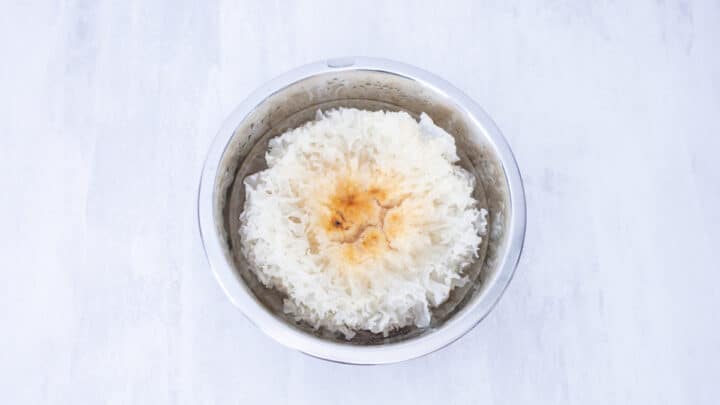
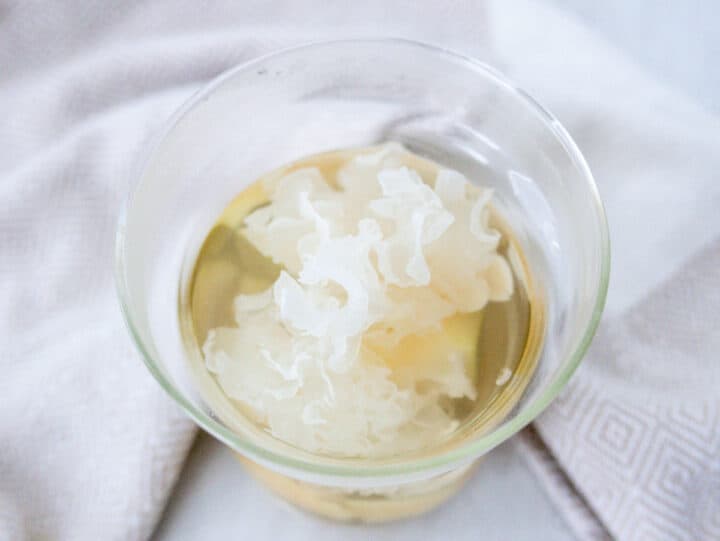
Soak the snow fungus in cold water for two to three hours, or overnight if you plan ahead. It expands to roughly six times its dry size, so use a bowl bigger than seems sensible. Snip off the hard yellow base with scissors and tear the rest into bite-sized florets.
Rinse the apricot kernels and soak them separately for twenty minutes. Drain, and discard the soaking water. This removes dust and takes the edge off the north kernels.
Add the tremella, apricot kernels, red dates and 1.5 litres of cold filtered water to a ceramic or enamelled pot. Bring it to a boil, then drop to a bare simmer. Cover partially and leave it alone for sixty minutes.
What you're waiting for is broth that turns faintly viscous and coats the back of a spoon. That gel is the whole point of the soak. Stainless steel works, though ceramic holds a gentler heat and gives better texture.
Wash the papaya, trim the ends, halve it lengthwise and scoop the seeds. Leave the skin on if you like, since it holds the wedges together and lends the broth a faint blush. Cut into 4 cm chunks.
Add the papaya and rock sugar at the sixty-minute mark and simmer another ten to fifteen. That window softens the fruit through while leaving the edges intact. Toss in goji berries for the final five, taste, and adjust the sugar.
Double-stew method. Put everything except papaya and goji into a stew pot inside a Buydeem or a double boiler, set to bird's nest or herbal mode, and run ninety minutes. Add the fruit for the last fifteen.
Skip the pressure cooker. It bruises the papaya and flattens the colour.
Storage and Make-Ahead
The finished dessert keeps four days in the fridge in a sealed glass container. It thickens noticeably when cold, so loosen it with a splash of hot water as you reheat.
Freeze the tremella base without fruit for up to two months. Papaya turns mealy after thawing, so add it fresh on the day. That single change is the difference between a freezer stash you actually eat and one you quietly throw out in November.
You can also cook the base ahead, refrigerate it three days, and finish with papaya and sugar in fifteen minutes on a weeknight. That's the version that gets made.
Serve it chilled through late August, then switch to hot once the mornings turn. Cold food slows digestion, so anyone with a weak spleen should keep it warm year-round.
Variations
Swap the papaya for Asian pear once October arrives and dryness stops being seasonal. Pear runs cooler and clears more heat, so add three slices of ginger to keep the bowl balanced.
A tablespoon of soaked peach gum turns the texture bouncier, which is the direction Cantonese kitchens take it when dryness is the complaint. Add it at the start with the tremella. If that direction appeals, the snow nest coconut milk and peach gum soup doubles down with two resins and full-fat coconut milk.
Dried lily bulb and lotus seeds move this toward the classic autumn formula, which is exactly what the autumn dryness lotus seed and snow fungus dessert does. Sago pearls make it a kid's dessert. Add 100 ml of coconut milk in the final five minutes for a richer bowl, less traditional and considerably harder to stop eating.
If you make tong sui weekly, the Buydeem Health Beverage Maker handles the hour-long simmer without anyone watching the pot. I use it for every dessert soup on this site.
Papaya vs Peach vs Asian Pear: Which Snow Fungus Dessert Suits You
Same tremella base, three different fruits, three different bodies. The peach post sorts these by season, which is the right question in August. This one sorts them by constitution, which is the right question if cooling foods have ever left you bloated.
Papaya is the neutral one and the safest default. Peach runs warm and suits anyone who feels the cold. Pear runs cool and belongs to people with clear heat signs, which is a smaller group than the internet suggests.
| Papaya 木瓜 | Peach 桃 | Asian Pear 雪梨 | |
|---|---|---|---|
| Suits which constitution | Qi deficient, weak spleen, anyone who runs cold | Yang deficient, cold constitution, blood deficient | Yin deficient with heat signs |
| TCM nature | Neutral, sweet | Warm, sweet and slightly sour | Cool, sweet and slightly sour |
| Meridians | Spleen, Stomach | Lung, Stomach, Large Intestine | Lung, Stomach |
| Primary action | Harmonizes the Stomach, aids digestion, moistens the Lung | Generates fluids, eases thirst, moistens the intestines | Clears heat, moistens the Lung, transforms phlegm |
| Pick it when | You bloat after meals, feel cold easily, or cooling foods usually disagree | Dryness arrives with lingering heat, stools run dry, hands stay cold | Dry unproductive cough, scratchy throat, hot palms, deep autumn dryness |
| Skip it when | Dampness is active: heavy limbs, thick greasy tongue coating | You have clear heat signs like night sweats or a flushed face | Loose stools, cold constitution, or a weak spleen |
| Load on digestion | Lightest of the three | Moderate. The sour note can aggravate reflux | Heaviest. Coolest of the three by a wide margin |
| Adjustment | None needed. Add red dates if you run very cold | Cut the rock sugar if you overheat easily | Add three slices of ginger to offset the cool nature |
| Recipe | You're reading it | Stewed peach, snow fungus and red dates | Double-steamed snow pear with fritillaria |
| Papaya 木瓜 | Peach 桃 | Asian Pear 雪梨 | |
|---|---|---|---|
| Suits which constitution | Qi deficient, weak spleen, anyone who runs cold | Yang deficient, cold constitution, blood deficient | Yin deficient with heat signs |
| TCM nature | Neutral, sweet | Warm, sweet and slightly sour | Cool, sweet and slightly sour |
| Meridians | Spleen, Stomach | Lung, Stomach, Large Intestine | Lung, Stomach |
| Primary action | Harmonizes the Stomach, aids digestion, moistens the Lung | Generates fluids, eases thirst, moistens the intestines | Clears heat, moistens the Lung, transforms phlegm |
| Pick it when | You bloat after meals, feel cold easily, or cooling foods usually disagree | Dryness arrives with lingering heat, stools run dry, hands stay cold | Dry unproductive cough, scratchy throat, hot palms, deep autumn dryness |
| Skip it when | Dampness is active: heavy limbs, thick greasy tongue coating | You have clear heat signs like night sweats or a flushed face | Loose stools, cold constitution, or a weak spleen |
| Load on digestion | Lightest of the three | Moderate. The sour note can aggravate reflux | Heaviest. Coolest of the three by a wide margin |
| Adjustment | None needed. Add red dates if you run very cold | Cut the rock sugar if you overheat easily | Add three slices of ginger to offset the cool nature |
| Recipe | You're reading it | Stewed peach, snow fungus and red dates | Double-steamed snow pear with fritillaria |
If you're unsure which column you're in, start with papaya. Neutral ingredients rarely make anything worse, and you can adjust from there once you see how your digestion responds.
Papaya Dessert Soup Frequently Asked Questions (FAQs)
Semi-ripe, meaning mostly green with a yellow blush and firm to the touch. Fully ripe fruit dissolves into pulp within ten minutes and muddies the broth. Fully green fruit stays firm and bland no matter how long you simmer it. Save the ripe ones for eating out of hand, and use green papaya for the savoury vegan papaya and black-eyed pea soup instead.
Three usual suspects. It didn't get a full hour at a real simmer, the head was bleached and had no gel to give, or you used too much water. Stick to 15 grams dried tremella per 1.5 litres and give it the time.
Ripe and semi-ripe papaya is generally fine, but unripe green papaya contains latex that's traditionally avoided in pregnancy. Tremella, red dates and rock sugar are eaten routinely in Cantonese households throughout pregnancy. Keep the sugar modest and check with your care provider, particularly if you're managing gestational diabetes.
Ten to twelve grams total for a 1.5 litre pot, roughly three parts sweet south kernel to one part bitter north kernel. North kernels contain amygdalin and must be cooked. Don't scale them up because more feels more medicinal.
Yes, though it tastes gentle rather than flat, since red dates and ripe papaya carry real sweetness. Monk fruit and stevia work, added off the heat. Fair warning that rock sugar isn't only a sweetener here, so you lose a small piece of the formula.
Chilled from late July through the end of August, hot from September onward. Cool it to room temperature first, then refrigerate at least four hours. Anyone who bloats easily or runs cold should stick to warm.
Two or three times a week through late summer and autumn is plenty. Daily works if your skin and throat run genuinely dry, though the sugar accumulates.
You can, at high pressure for twenty minutes with natural release, then add papaya on sauté for five. The colour suffers and the texture lands less silky. A slow stovetop simmer is worth the extra half hour if you have it.
Anyone carrying active dampness, meaning heavy limbs, bloating after meals, or a thick greasy tongue coating. A yin tonic adds fluid to a body already struggling to move it. Clear the dampness first, then come back once dryness is the bigger complaint.
It's one of the better ones for children. Halve the rock sugar, chop the papaya and tremella smaller, and pit the red dates carefully. Most kids take to the texture faster than adults do, which says something about adults.
Other Yin Nourishing Dessert Recipes
If the tremella is already out, the stewed peach, snow fungus and red dates dessert is the same base with Okanagan peaches while they last. Peach runs warm rather than neutral, so it suits anyone who finds papaya too cooling.
The autumn dryness relief lotus seed and snow fungus dessert swaps fruit for lotus seeds and lily bulbs, which pushes the formula from fluid-generating toward spirit-calming. Make that one once October dryness sets in properly.
For a dry cough that's actually taken hold, double-steamed snow pear with fritillaria bulb sits closer to the medicine end of the spectrum. Chuan bei mu is a proper herb, not a fruit.
The snow nest coconut milk and peach gum soup is the indulgent version, two tree resins and full-fat coconut milk aimed at skin hydration. It needs an overnight soak, so plan a day ahead.
Savoury instead? The vegan papaya soup with black-eyed peas uses green papaya to drain dampness rather than moisten dryness. Opposite job, same fruit.
For delicious Chinese comfort food recipes and TCM food therapy that actually work, subscribe to our newsletter and never miss a wellness post!
I'd love to see how you went with my recipes! Leave a comment below or tag me on Instagram @INSTANOMSS #INSTANOMSS.
> Recipe Card
PrintChinese Papaya Dessert with Snow Fungus 木瓜雪耳糖水
A Cantonese tong sui that simmers semi-ripe papaya with snow fungus, apricot kernels and rock sugar into a silky, lightly sweet dessert soup. Nourishes yin, moistens the Lung, and works hot or chilled.
- Prep Time: 15 mins
- Cook Time: 75 mins
- Total Time: 1 hour 30 minutes
- Yield: 4 persons 1x
- Category: Dessert
- Method: Stew, Boil
- Cuisine: Chinese, TCM
- Diet: Vegan
Ingredients
- 15g dried snow fungus (雪耳), 1 medium head, soaked
- 1 semi-ripe papaya (about 600g), seeded and cut into 4 cm chunks
- 10 to 12g south and north apricot kernels (南北杏), roughly 3:1
- 8 red dates (紅棗), pitted
- 1 tbsp goji berries (枸杞)
- 40 to 50g yellow rock sugar (黃冰糖), to taste
- 1.5 L cold filtered water
Optional
- 20g dried lily bulb (百合)
- 20g dried lotus seeds (蓮子), cores removed
- 1 tbsp soaked peach gum (桃膠)
- 100 ml full-fat coconut milk
Instructions
- Soak the snow fungus in cold water 2 to 3 hours until fully expanded. Snip off the hard yellow base and tear into bite-sized florets.
- Rinse and soak the apricot kernels 20 minutes. Drain and discard the water.
- Add tremella, apricot kernels, red dates and 1.5 L cold water to a ceramic or enamelled pot. Bring to a boil, then reduce to a gentle simmer.
- Cover partially and cook 60 minutes, until the broth turns slightly viscous.
- Add the papaya chunks and rock sugar. Simmer 10 to 15 minutes, until the fruit softens but holds its shape.
- Add goji berries in the final 5 minutes. Taste and adjust sweetness.
- Serve hot, or cool to room temperature and refrigerate at least 4 hours to serve chilled.
Equipment

BUYDEEM electric Food Steamer for Cooking
Buy Now → Buy Now →
  Buy Now →
  Buy Now →
  Buy Now →
  Buy Now →
 Notes
Updated August 2026: this recipe now calls for semi-ripe papaya and a corrected apricot kernel quantity. Earlier comments refer to the previous version.
- Soak the snow fungus in cold water 2 to 3 hours until fully expanded. Snip off the hard yellow base and tear into bite-sized florets.
- Rinse and soak the apricot kernels 20 minutes. Drain and discard the water.
- Add tremella, apricot kernels, red dates and 1.5 L cold water to a ceramic or enamelled pot. Bring to a boil, then reduce to a gentle simmer.
- Cover partially and cook 60 minutes, until the broth turns slightly viscous.
- Add the papaya chunks and rock sugar. Simmer 10 to 15 minutes, until the fruit softens but holds its shape.
- Add goji berries in the final 5 minutes. Taste and adjust sweetness.
- Serve hot, or cool to room temperature and refrigerate at least 4 hours to serve chilled.
Nutrition
- Serving Size: 1 bowl
- Calories: 105
- Sugar: 14.1 g
- Sodium: 23.8 mg
- Fat: 3.3 g
- Carbohydrates: 19.4 g
- Fiber: 2.7 g
- Protein: 1.7 g
- Cholesterol: 0 mg

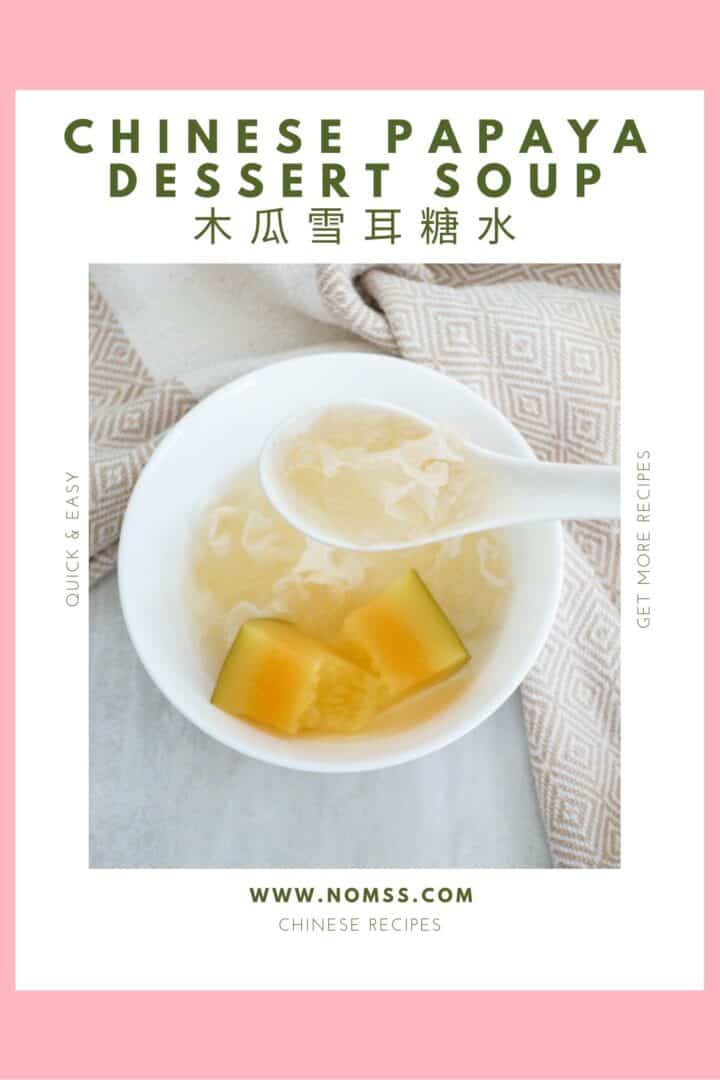
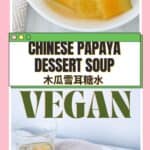
PIN the above image to your Asian Plant-Based Recipe Board to bookmark this page! We are so excited to share our recipes with you!
MORE VEGAN RECIPES:
- Super Alkaline Kale Salad
- Double-Steamed Snow Pear with Fritllaria Bulb Recipe 川貝燉雪梨
- Hawthorn Goji Berry Tea 山楂杞子茶
- Air Fryer Salt and Pepper Tofu
- Vegan Okonomiyaki Cauliflower Bites
- Anti-Inflammatory Vegan
- Hojicha Oat Milk Nice Cream (No Churn, Egg Free, Dairy Free)
- No Mayo Apple Vinegar Coleslaw





Andrea says
i love papaya and this dessert really hit the spot! so good!
Nancy says
It's the tastiest self care beauty routine!!
Holly says
I'm intrigued by this recipe! I've never seen snow fungus but will be on the lookout for it now.
Nancy says
You should be able to find it at most asian supermarkets if not at your local herbalist. I have linked it on my Amazon store too!
Katie says
This chinese papaya dessert is so good!
Nancy says
It super refreshing isn't it?
Marie B says
How interesting! Did know about this fungus ingredient... gonna be on the look out for this now! Thanks for sharing!
Nancy says
Snow Fungus is the perfect inexpensive skincare / beauty ingredient! Glow on!
Judith says
So tasty, and easy to make too!
Cindy says
Such a creative and lovely dessert! Bonus that it has medicinal qualities!
Michelle says
So creative, I love this!!
Sisley White - Sew White says
I adore papaya and getting to enjoy it as a dessert is so good.
Choclette says
I do love your recipes Nancy. There's always something to learn. Who would have thought snow fungus for dessert. Love it.
Emily says
I had never tried anything like this before! We really enjoyed this dessert cold, it was so refreshing!
Jo Keohane says
Have never made a papaya dessert - must give this a try!
Janice says
Beauty definitely comes from the inside out! What a fascinating recipe.
Linda says
This dessert bowl is my favorite, especially with extra snow fungus!
Andrea says
this papaya dish looks incredible! so sweet and delicious!
Nicola says
This sounds so interesteing! Never heard of snow fungus but very interested to see what this is like 🙂
Keri says
We made this soup hot, and it was so unusually delcious! I'm so happy I found your site. Thank you!
Katie says
Love this vegan dessert! Papaya is a favorite of mine!
Cindy Mom the Lunch Lady says
What a lovely dessert. I will need to look for snow fungus and try making this!
Kat says
Wow snow fungus is so beautiful and this is a wonderful way to enjoy it!
Bianca says
Omg this was so good! Definitaly making this again
Freya says
A delicious and unusual dessert, I prefer it coke, but it is perfect either way!
Marcelllina says
So refreshing!
Alexandra says
What a delicious and refreshing dessert!
Nancy says
do you prefer it hot or cold ?
Amy says
So good! Thank you!
Sue says
This is the ultimate good for you dessert!
Nancy says
Yes, it is super tasty and nourishing at the same time!
Andréa Janssen says
Beautiful dessert recipe and so easy to prepare!
Nancy says
Glad to hear you loved it!
Jean says
my first papaya dessert and it was so delicious. planning to make again and share with Chinese friends.
Nancy says
hooray! wasn't it SO EASY to make?
Nora says
That sounds great! Will try your recipe next weekend! Thanks for the great idea!
Nancy says
enjoy!