
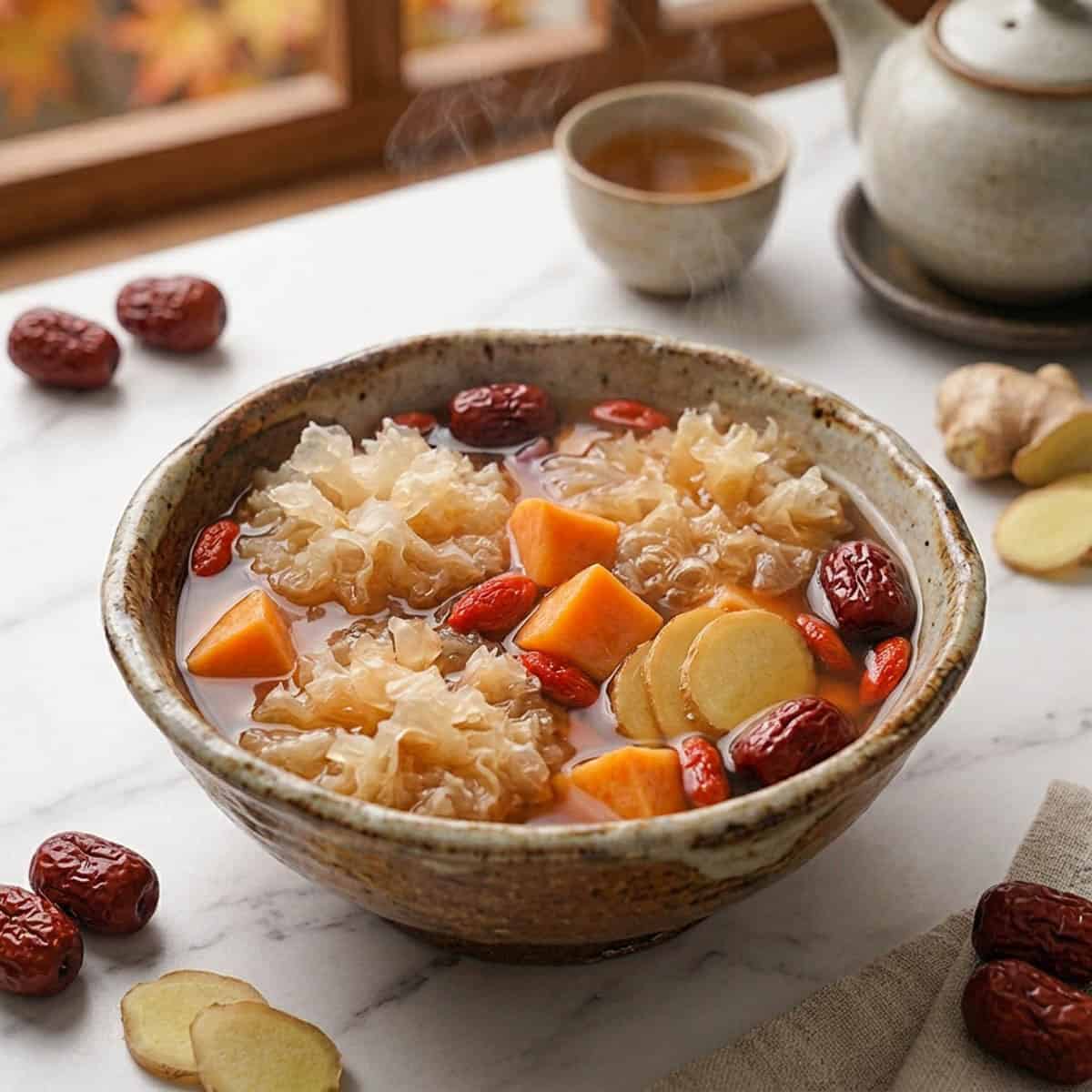
Sweet Potato Tong Sui with Tremella and Ginger 薑汁番薯雪耳糖水
Peach season is done and the nights have turned. This is the bowl that takes over: sweet potato and tremella for the dryness, ginger and slab sugar for the cold that shows up after dark.
Cantonese kitchens have made Sweet Potato Tong Sui 番薯糖水 forever, usually as a plain sweet potato and ginger soup. Adding tremella gives it body and a faint gel, which turns a comfort dessert into something that does a job. One pot, no overnight soak, under a dollar a serving.
My cousin used to tease me that sweet potatoes make you fart, so I avoided them for years. The irony is that simmering them slowly with ginger is exactly what settles that, which is the whole reason the ginger is in this pot.
< In This Post: Everything You'll Need for Sweet Potato Tong Sui
You'll learn which sweet potato holds its shape and which one turns your broth to sludge, plus the ten-minute trick that keeps the liquid clear. We'll cover the TCM reasoning behind pairing a neutral root vegetable with a cooling fungus and warming ginger, and why that combination beats a fruit-based tong sui once September arrives.
There's a sourcing section with real T&T and Costco numbers, freezer prep that works for a family, and the cost per bowl against a tong sui shop. Plus an Instant Pot method, a comparison table for autumn swaps, and ten questions I get asked constantly.
Jump to:
- < In This Post: Everything You'll Need for Sweet Potato Tong Sui
- Ingredients and Chinese Herbal Benefits: TCM Properties
- Ingredient Notes and What to Look For
- How to Make Sweet Potato Tong Sui
- Why Did My Sweet Potato Dissolve?
- Storage and Make-Ahead
- Variations
- Sweet Potato Tong Sui Frequently Asked Questions (FAQs)
- Other Autumn TCM Desserts on Nomss
- > Recipe Card
- Sweet Potato Tong Sui with Tremella and Ginger 薑汁番薯雪耳糖水

Why Sweet Potato, Tremella and Ginger Work Together
Early autumn hands you an awkward problem. Dryness starts pulling at the Lung, but the nights have already turned cold, and most moistening foods run cool while most warming foods run dry.
Sweet potato (番薯) solves it. Sweet and neutral, entering the Spleen, Stomach and Kidney meridians, it tonifies Spleen qi and moistens the intestines without cooling the middle at all. Folk custom in parts of Zhejiang holds that eating it at White Dew settles the stomach for the year, and the farming proverb 白露起,紅薯生 marks early September as harvest.
Tremella (雪耳) handles the yin half of the work. Sweet, bland and neutral, it nourishes yin and moistens dryness, and the gel it releases is that principle made visible in the bowl.
Ginger (生薑) is what makes this seasonal rather than generic. Pungent and slightly warm, it keeps a moistening dessert from sitting cold on a September stomach. Leave it out and you'll notice within the hour.
For the full seasonal picture, my White Dew 白露 TCM food guide covers what changes on September 7 and why ginger comes back into every pot.
This is food therapy, not medical treatment. Anything persistent belongs in front of a doctor or a registered TCM practitioner.
Ingredients and Chinese Herbal Benefits: TCM Properties
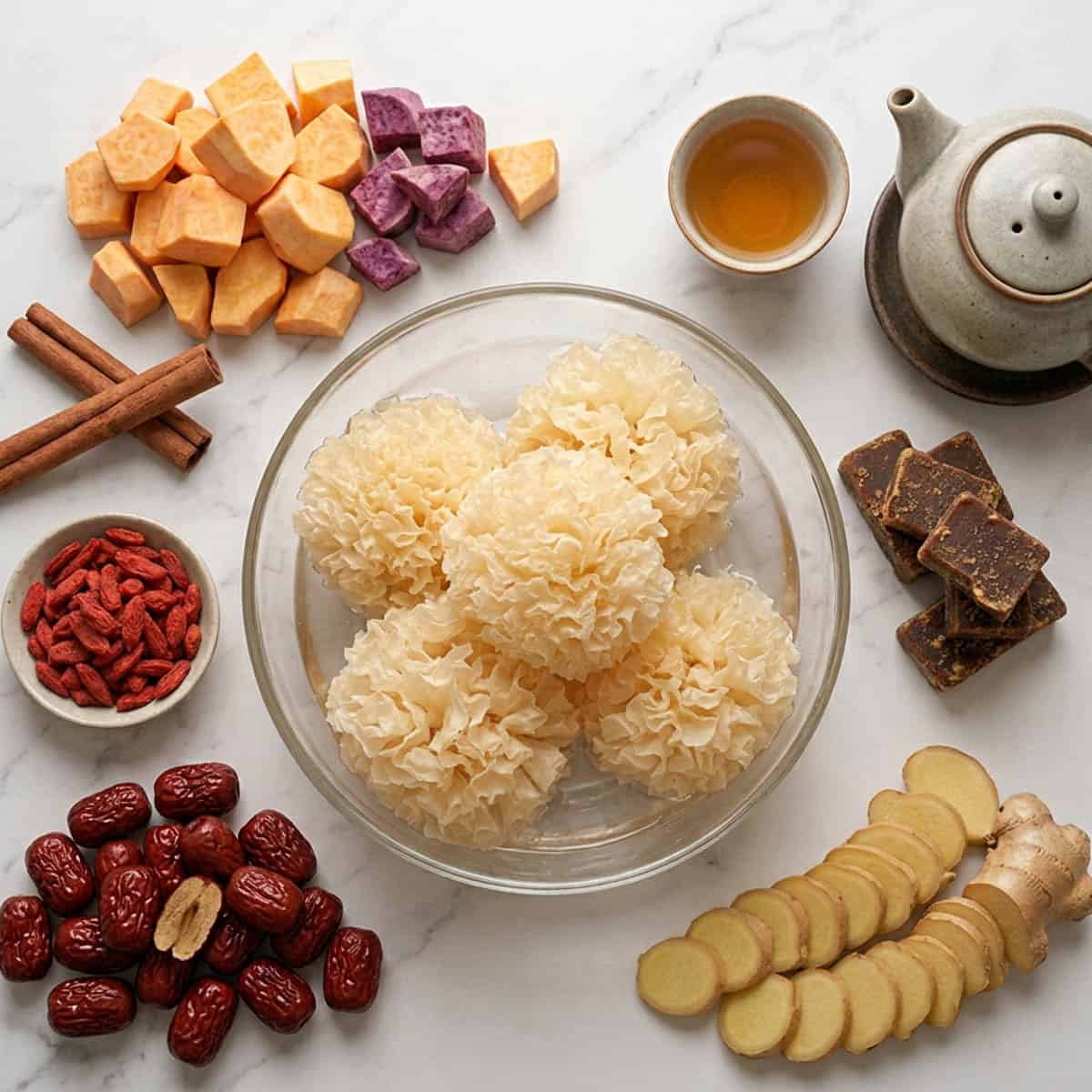
Sweet Potato (番薯, Fān shǔ) anchors the bowl. Sweet and neutral, it tonifies Spleen qi, generates fluids and moistens the large intestine. Unlike pear or papaya, it adds moisture without taking warmth away from digestion.
Snow Fungus (雪耳, Xuě ěr) is sweet, bland and neutral, working on the Lung, Stomach and Kidney. It nourishes yin and moistens dryness, and its polysaccharides hold water in a way you can see in the texture. Cantonese kitchens have called it the poor cook's bird's nest for about a century.
Fresh Ginger (生薑, Shēng jiāng) is pungent and slightly warm, entering the Lung, Spleen and Stomach. Here it does one job: stopping a cooling dessert from chilling the middle. Six coins minimum for a 1.5 litre pot.
Red Dates (紅棗, Hóng zǎo) are sweet and warm, targeting Spleen and Stomach. They tonify qi, nourish Blood, and keep the formula from tipping cool. They also handle roughly a third of the sweetening before any sugar arrives.
Slab Sugar (片糖, Piàn táng) is warm and sweet, entering Spleen and Lung. It carries a molasses note that pairs naturally with ginger, and it moistens rather than simply sweetening.
Goji Berries (枸杞, Gǒu qǐ) are sweet and neutral, nourishing Liver and Kidney yin. Five minutes at the end, and no longer, or they turn to mush.
Ingredient Notes and What to Look For
Disclosure: some links below are Amazon Associates links for Amazon.ca and Amazon.com. If you buy through them I earn a small commission, and your price stays the same.
Buy dried snow fungus in pale ivory or faint yellow whole heads. Bright white means sulphur-bleached, which smells faintly chemical and never gels properly no matter how patient you are.
Choose orange-fleshed sweet potato over Japanese purple-skin. Garnet and Beauregard hold their shape and give the broth its colour, while Japanese sweet potato goes floury and clouds everything. Look for firm tubers, since a bruised one collapses faster in the pot.
Slab sugar comes in golden bricks near the rock sugar, roughly 60g each, so snap it rather than guessing. Yellow rock sugar (黃冰糖) substitutes cleanly for a lighter finish. Ginger should be young and thin-skinned in September, not the fibrous winter stuff.
Buying This in Canada and the US
T&T handles the dried goods in one trip. Tremella runs roughly $9 to $12 for a 250g bag of whole heads, which works out to about fifteen heads, and one head makes one pot. A single bag carries you from early September through to Frost Descent.
Red dates cost $11 to $14 for 500g, or somewhere near 160 dates. That's twenty batches. Pay the extra for pre-pitted unless you find pitting eight dates at nine in the evening genuinely relaxing.
Costco covers the sweet potatoes. The 4.5kg bags sit in produce through the autumn for around $11, a fraction of the per-pound price elsewhere, and they keep six weeks in a cool dark cupboard.
Rough cost per pot at the time of writing: one tremella head $0.65, eight red dates $0.60, 700g sweet potato $1.65, and about $1.00 for ginger, sugar and goji. Call it $3.90 for five servings, or $0.78 a bowl. A Vancouver tong sui shop charges $8 to $11 before tax.
For freezer prep, cook the tremella and red date base without the sweet potato, cool it, then freeze in 300ml portions for up to two months. Thaw overnight, add fresh sweet potato, and you're eating in twenty-five minutes.
How to Make Sweet Potato Tong Sui
Soak the tremella in cold water for two to three hours until it expands to roughly six times its dry size. Snip off the hard yellow base with scissors and tear the rest into bite-sized florets, because that base stays tough no matter what you do to it.
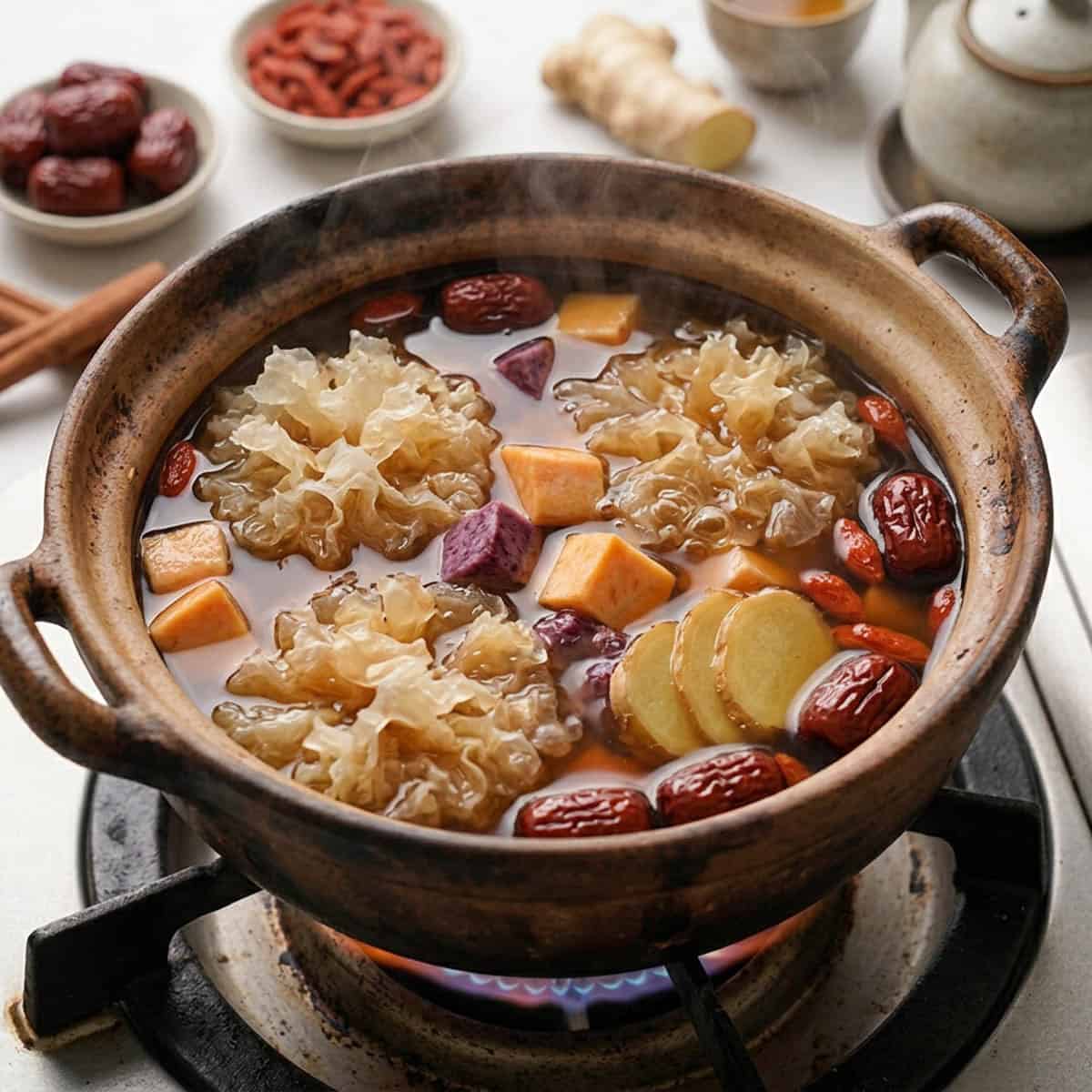
Add the tremella, pitted red dates, ginger coins and 1.5 litres of cold filtered water to a ceramic or enamelled pot. Bring it to a boil, drop to a bare simmer, cover partially, and leave it forty-five minutes. What you want is broth that turns faintly viscous and clings to a spoon.
Peel the sweet potato while that runs and cut it into 3cm chunks. Drop the chunks into cold water for ten minutes, then drain. That soak pulls off surface starch and is the whole difference between clear amber broth and orange sludge.
Add the sweet potato and slab sugar at the forty-five minute mark, then simmer another twenty to twenty-five minutes. A chopstick should meet slight resistance going through a chunk. Don't stir once the potato is in, since agitation is what breaks it down.
Toss in the goji berries for the final five minutes, taste, and adjust. Serve hot, which is rather the point.
Why Did My Sweet Potato Dissolve?
Three things cause it, and all three are fixable. You added the chunks too early, which gives them fifty minutes in the pot instead of twenty-five. You stirred, and agitation breaks down cooked starch faster than heat does. Or you cut them under 2cm, where there isn't enough mass to survive the simmer.
The fourth cause is the variety. Japanese purple-skin sweet potato goes floury no matter how carefully you cook it, so use orange-fleshed Garnet or Beauregard instead.
Storage and Make-Ahead
The finished tong sui keeps four days in a sealed glass container. It thickens considerably when cold, so loosen it with a splash of hot water and reheat gently on the stovetop.
Freezing the finished dessert is a mistake. Tremella survives it fine, but sweet potato turns grainy and watery on thaw, so freeze the base only and add fresh potato after.
Cooking the base on Sunday and finishing it twice during the week is the version that actually gets made. Ask me how I know.
Variations
Swap the sweet potato for taro (芋頭) once October arrives, or for kabocha if you want something in between. Each behaves differently in the pot.
| Swap | Texture | Simmer time | Best for |
|---|---|---|---|
| Sweet potato (番薯) | Holds shape, silky | 20 to 25 min | Early autumn, weak digestion |
| Taro (芋頭) | Starchy, thickens broth | 15 min | Late autumn cold, heavier appetite |
| Kabocha (南瓜) | Soft, breaks down readily | 12 to 15 min | Sweeter bowl, kids |
By November the taro version is the one to make. My Start of Winter 立冬 guide covers what else changes in the kitchen from November 7. A handful of dried longan (桂圓) pushes this warmer and more caramelly, which nods to the Fuzhou custom of eating longan at White Dew. Add it at the start so it has time to soften. Coconut milk, 100ml stirred in during the last five minutes, moves the whole thing toward bubur cha cha and is considerably harder to stop eating.
For anyone building an autumn rotation, a ceramic soup pot holds gentler heat than stainless steel and gives noticeably better tremella gel.
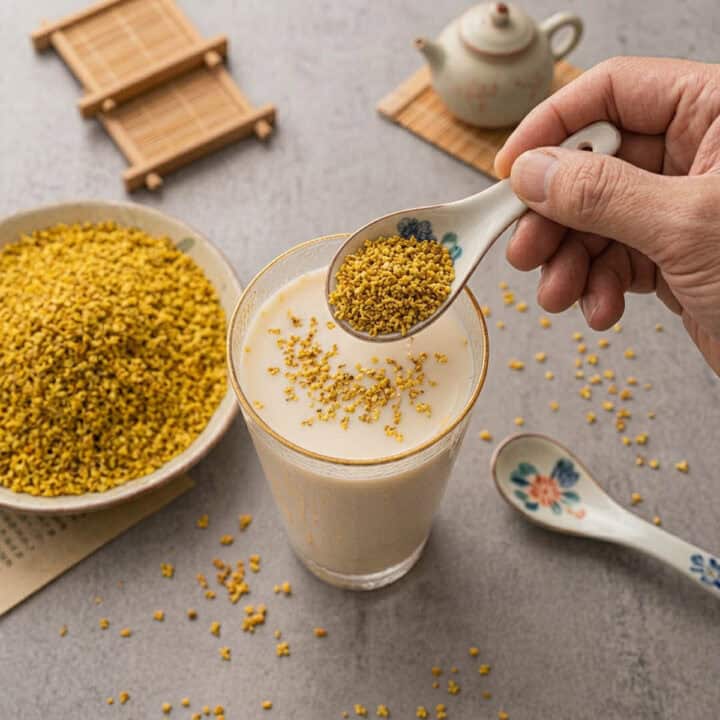
A teaspoon of sweet osmanthus sauce stirred in at the end makes the bowl smell like Mid-Autumn. If you'd rather drink your osmanthus, my osmanthus honey milk does the same autumn job in a mug.
Sweet Potato Tong Sui Frequently Asked Questions (FAQs)
Orange-fleshed varieties like Garnet or Beauregard. Japanese purple-skin goes floury and clouds the broth.
Peel it. The skin toughens over a long simmer and shreds into the broth, which is unpleasant in a dessert.
Almost always bleached product. Bright white tremella has been sulphured and won't release its polysaccharides no matter how long you simmer.
Yes. Yellow rock sugar gives a cleaner, less molasses-forward finish. For lower sugar, lean on extra red dates and add monk fruit off the heat.
You can, but you shouldn't in September. Without it the bowl runs cool, which is exactly wrong once the nights turn.
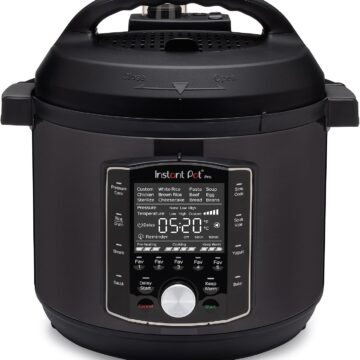
High pressure twelve minutes with natural release, then sauté eight minutes with the sweet potato and sugar. The gel lands slightly thinner than stovetop.
In August, yes. From White Dew onward, serve it hot, since chilled tong sui on a cold stomach causes the bloating you're trying to avoid.
Sweet potato, tremella, red dates and ginger are gentle everyday foods in Cantonese households. Keep the sugar modest and check with your care provider if you're managing gestational diabetes.
Anyone in an active cold with heavy phlegm, and anyone carrying dampness with bloating and a thick greasy tongue coating. Clear that first.
Other Autumn TCM Desserts on Nomss
Once dryness stops being seasonal and turns serious, Autumn Dryness Relief TCM Lotus Snow Fungus Dessert 蓮子百合雪耳紅棗杞子糖水 is the next bowl. Lotus seeds and lily bulbs push the formula toward spirit-calming, which suits the stretch after the Autumn Equinox.
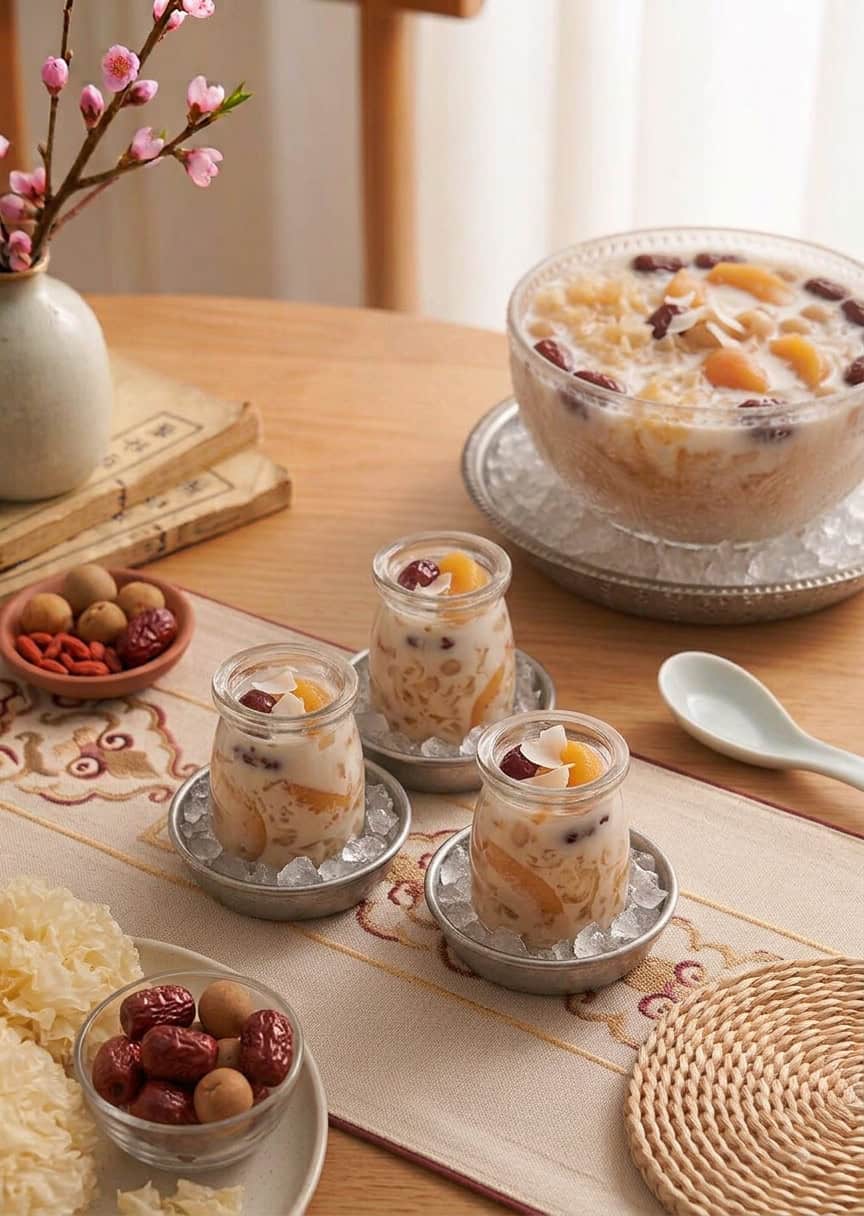
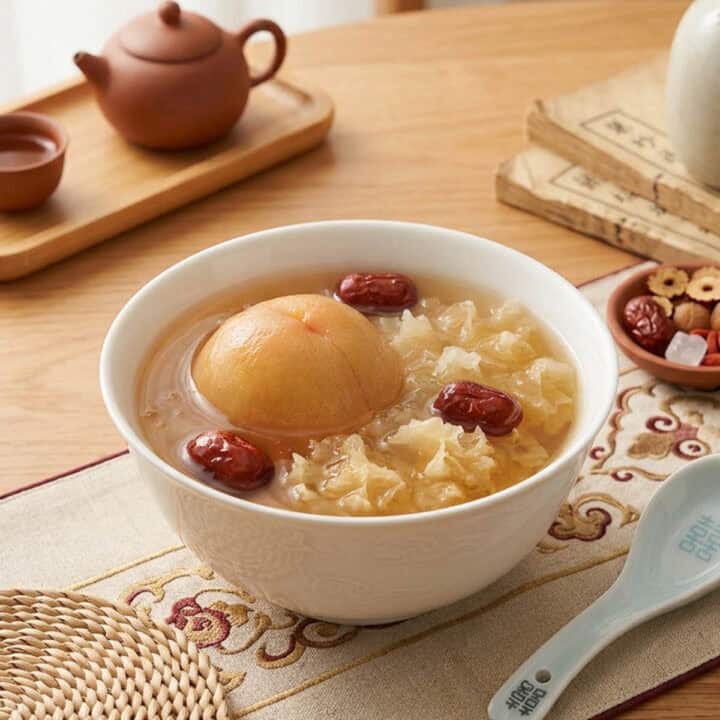
If the heat hasn't broken where you are, Stewed Peach, Snow Fungus and Red Dates Dessert 養生桃子銀耳羹 catches the last Okanagan peaches. It's the warmer-fruit version of the same idea, and it belongs to Chushu rather than White Dew.
For traditional Chinese soups, healing recipes, and TCM food therapy that actually work, subscribe to our newsletter and never miss a wellness post!
I'd love to see how you went with my recipes! Leave a comment below or tag me on Instagram @INSTANOMSS #INSTANOMSS.
> Recipe Card
PrintSweet Potato Tong Sui with Tremella and Ginger 薑汁番薯雪耳糖水

A Cantonese tong sui that simmers sweet potato with tremella, red dates and fresh ginger into a warm, lightly gelatinous dessert soup. Moistens autumn dryness while keeping the middle warm as the nights turn cold.
- Prep Time: 15 mins
- Cook Time: 70 mins
- Total Time: 1 hour 25 minutes
- Yield: 5 persons 1x
- Category: Dessert
- Method: Boil
- Cuisine: Chinese, TCM
- Diet: Vegan
Ingredients
- 15g dried snow fungus (雪耳), 1 medium head, soaked
- 700g orange sweet potato (番薯), peeled, cut into 3cm chunks
- 8 red dates (紅棗), pitted
- 6 coins fresh ginger (生薑), skin on
- 50 to 60g slab sugar (片糖) or yellow rock sugar (黃冰糖), to taste
- 1 tbsp goji berries (枸杞)
- 1.5L cold filtered water
Optional
- 25g dried longan (桂圓)
- 100ml full-fat coconut milk
- 2 pandan leaves, knotted
 Get Recipe Ingredients
 Instructions
- Soak the snow fungus in cold water 2 to 3 hours until fully expanded. Snip off the hard yellow base and tear into bite-sized florets.
- Add the tremella, pitted red dates, ginger coins and 1.5L cold water to a ceramic or enamelled pot. Bring to a boil, then reduce to a gentle simmer.
- Cover partially and cook 45 minutes, until the broth turns slightly viscous.
- Meanwhile, soak the sweet potato chunks in cold water 10 minutes, then drain.
- Add the sweet potato and slab sugar. Simmer 20 to 25 minutes without stirring, until a chopstick meets slight resistance.
- Add the goji berries in the final 5 minutes. Taste and adjust sweetness.
- Serve hot.

Notes
- Instant Pot: high pressure 12 minutes, natural release, then sauté 8 minutes with sweet potato and sugar.
- Do not stir after the sweet potato goes in.
- Freeze the tremella base only, up to 2 months. Add fresh sweet potato after thawing.
- Store 4 days refrigerated. Loosen with hot water when reheating.
- Avoid bright white tremella; bleached product will not gel.
- Not suitable during an active cold with heavy phlegm.
Nutrition
- Serving Size:
- Calories: 538
- Sugar: 84.7 g
- Sodium: 113.4 mg
- Fat: 4.9 g
- Carbohydrates: 116.4 g
- Fiber: 23.4 g
- Protein: 13.2 g
- Cholesterol: 0 mg

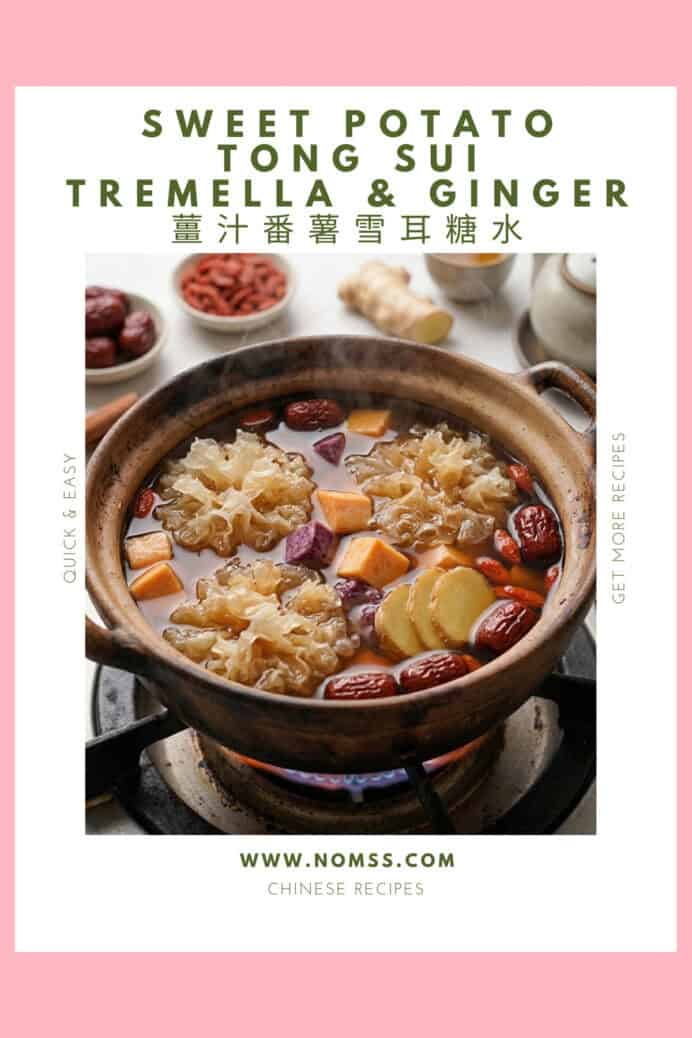
https://www.pinterest.ca/nomsscom/food-tcm-traditional-chinese-medicine/Pin the above image to your Chinese Medicinal Food Therapy TCM Recipe Pinterest Board to bookmark this page. We are so excited to share our recipes with you!
More Chinese Recipes
Chinese Steamed Chicken With Shiitake Mushroom 冬菇蒸雞
Air Fryer BBQ Pork Char Siu 氣炸鍋蜜汁叉燒
Red Bean Soup (Instant Pot) 蓮子百合紅豆沙



Comment Below